中文
有人问你「你还好吗」,你说还好。但胸口是紧的。喉咙是堵的。后背某个地方一直在用力,你说不上来是哪里。
身体已经知道了。语言还没跟上。
我在「带伤活着」里写过,创伤不住在记忆里,住在身体里。在「情绪在你身体里走过的路」里,我试着画出那条路径——焦虑从胃开始,愤怒卡在下巴,悲伤沉在胸口。
但那是我画的。你的身体,只有你知道。
所以我做了这个小工具。
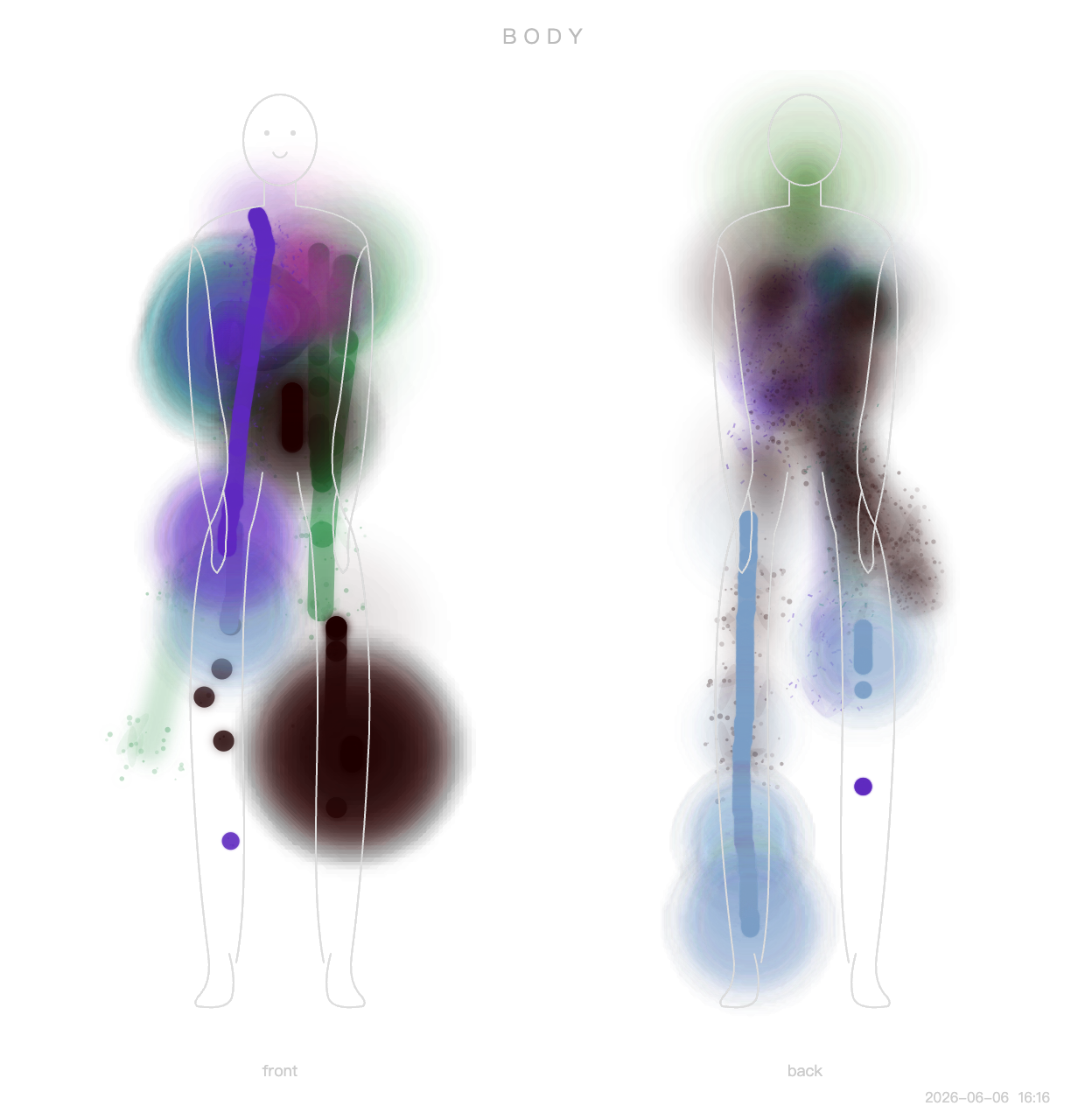
Body 是一个身体情绪地图。打开它,你会看到一个人体轮廓——正面和背面。你可以在上面画。
没有问卷,没有打分,没有「请选择你现在的情绪」。
就是一个身体,一些颜色,和你的手。
你可以选质感——有些感觉是重的,压在那里;有些是黏的,甩不掉;有些轻得几乎不在,但你知道它在。
你可以调温度——同样是胸口的一团黑,闷热的和冰冷的完全不同。你知道区别。工具也知道:冷的笔触硬、边缘锐利,热的会渗透、扩散。
你可以什么都不想,只管画。画快了,笔触会溅出细密的碎片;画慢了,边缘会柔化、扩散。你的节奏本身就是信息。
画完了,你可以在任何地方点一下,写一个字。「闷」。「冷」。「不知道」。或者什么都不写。工具不问你。
导出一张图,带日期和时间。过几天再画一张。也许会不一样。
---
这是「何苦开心」的第一个小工具。不大。但它从根上长出来的——和手册是同一棵树,和那篇身体地图是同一条路。
我一直说「活用精神分析」。这次不是文章,是一个你可以用手碰的东西。
免费。浏览器打开就能用。不保存任何数据。
English
Someone asks, "Are you okay?" You say you're fine. But your chest is tight. Your throat is blocked. Somewhere in your back, something is clenching, and you can't quite name where.
Your body already knows. Language hasn't caught up.
I've written before that trauma doesn't live in memory — it lives in the body. I've tried to map the paths emotions take: anxiety starts in the stomach, anger locks in the jaw, grief sinks into the chest.
But that was my map. Your body — only you know.
So I made this small tool.
Body is an emotional body map. Open it, and you'll see a human silhouette — front and back. You paint on it.
No questionnaires. No scoring. No "please select your current emotion."
Just a body, some colors, and your hand.
You choose a texture — some feelings are heavy, pressing down; some are sticky, impossible to shake; some are so light they're almost not there, but you know they are.
You set the temperature — the same dark patch on your chest feels completely different when it's burning versus freezing. You know the difference. The tool knows too: cold strokes are hard-edged and crystalline; hot ones bleed and spread.
You can stop thinking and just draw. Move fast, and the stroke shatters into particles. Move slow, and the edges soften into a bloom. Your pace is part of the picture.
When you're done, you can tap anywhere and leave a word. "Tight." "Cold." "I don't know." Or leave nothing. The tool doesn't ask.
Export a timestamped image. Come back in a few days and draw again. It might look different.
This is the first small tool from Why Be Happy. It's not big. But it grew from the same root as the CPTSD handbook and the body map essay.
I keep saying "living psychoanalysis." This time it's not an article — it's something you can touch with your hands.
Free. Runs in your browser. No data saved. Nothing leaves your screen.