Women & Queer Psychoanalysts, No. 4.
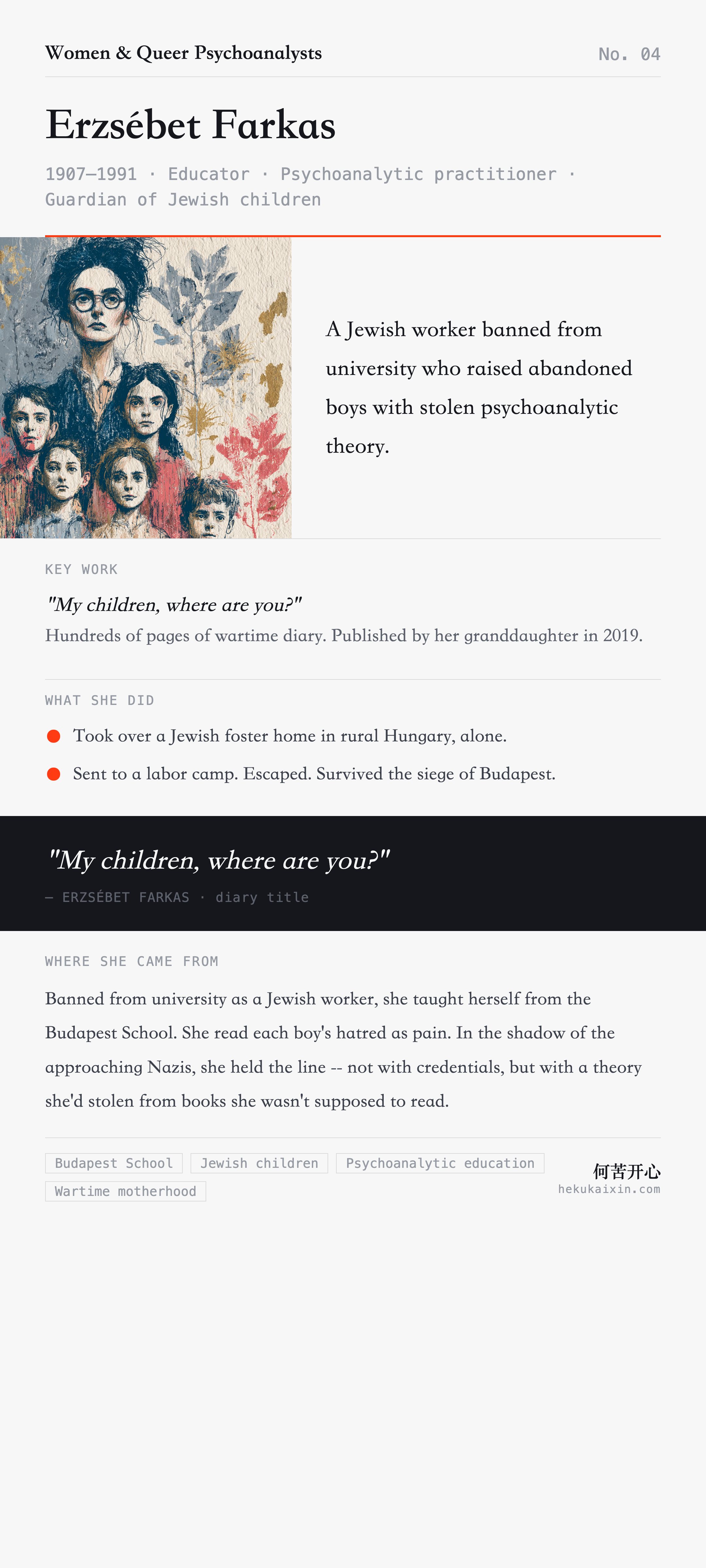
Erzsébet Farkas (1907–1991), Hungarian Jewish educator and psychoanalytic practitioner.
She was not a psychoanalyst — by institutional standards, she was nothing. Anti-Jewish laws barred her from university. But she attended the Budapest Psychoanalytic School's Wednesday seminars, teaching herself psychoanalytic theory through auditing and correspondence. In 1938, she took sole charge of a Jewish foster home in Békés, Hungary, raising a group of boys abandoned by their families.
The boys were full of aggression and fear. Others saw "problem children." Using theory she had smuggled out of the Budapest school, she read their hatred as pain, one child at a time — not innate violence, but a response to being cast out. She recorded her daily observations in a diary and sought supervision by letter from the analyst Kata Levy.
In 1944, she was forced into a labor camp. She escaped, and survived the siege of Budapest with her son.
Her diary ran to hundreds of pages. She titled it "My Children, Where Are You?" (Fiaim, hol vagytok?). In 2019, it was published by her granddaughter.